
Astigmatism : the astigmatic eye
Astigmatism is a type of refractive error caused by the irregularities in the shape of a person’s cornea. It is a very common condition: most people wearing glasses have astigmatism.

Do any of these situations sound familiar?
- When I’m looking at a grid, the lines look curved and difficult to distinguish from one another.
- I often make mistakes when using computer spreadsheets.
- I have difficulties seeing at night.
- I'm very dazzled by car headlights or streetlights.
It might be astigmatism.
It is not an eye disease nor an eye health issue. In this condition, the eye fails to focus the light equally on the retina, leading to blurred or distorted vision. Put simply, astigmatism is a problem with how the eye focuses light.
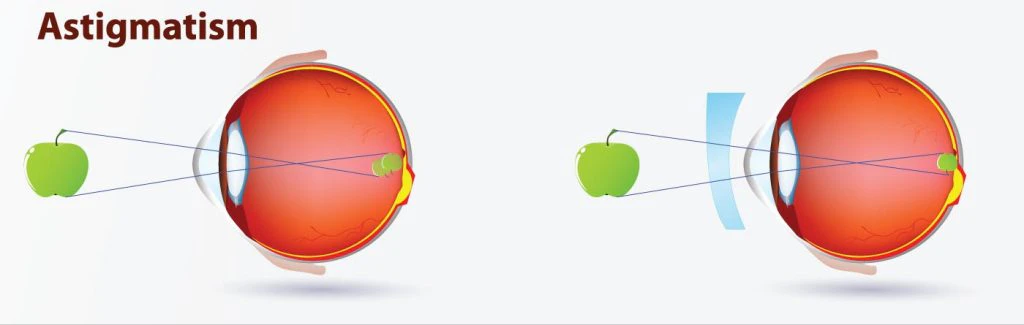
One can have it from birth or develop it gradually in life.
Symptoms of astigmatism might include blurred vision or some degree of vision distortion at any distances. Astigmatism can also cause dizziness, eye strain, headaches, squinting and eye irritation.

Nikon has developed a dual-side aspheric single-vision lens that is custom-made and calculated for each prescription, providing a high-accuracy correction for people with astigmatism and strong lens powers. This Nikon’s technology offers the highest level of visual performance and aesthetics.
Did you know? Astigmatism can affect depth perception
Depth perception is defined as the ability to observe the world in three dimensions. Some eye conditions, like astigmatism, make depth perception issues more apparent—making it difficult to determine the proximity or distance between two objects*.
*The Effects of Uncorrected Astigmatism on Dynamic Stereoacuity Hyung Ryul Jeong, Su A Jung, and Hyun Jung Kim Dept. of Optometry, Konyang University, Daejeon 35365, Korea (Received April 21, 2017: Revised May 20, 2017: Accepted June 5, 2017)