Getting To Know Your Eyes Better
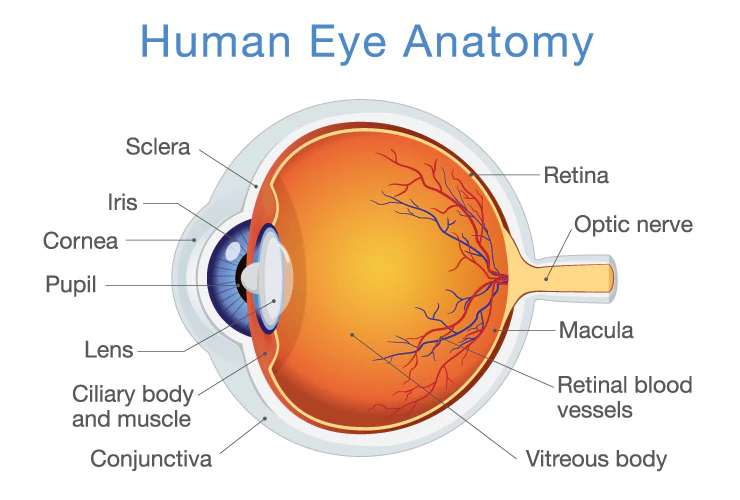
Although the human eye is much more complex than any man-made machinery, it can basically be compared to a camera.
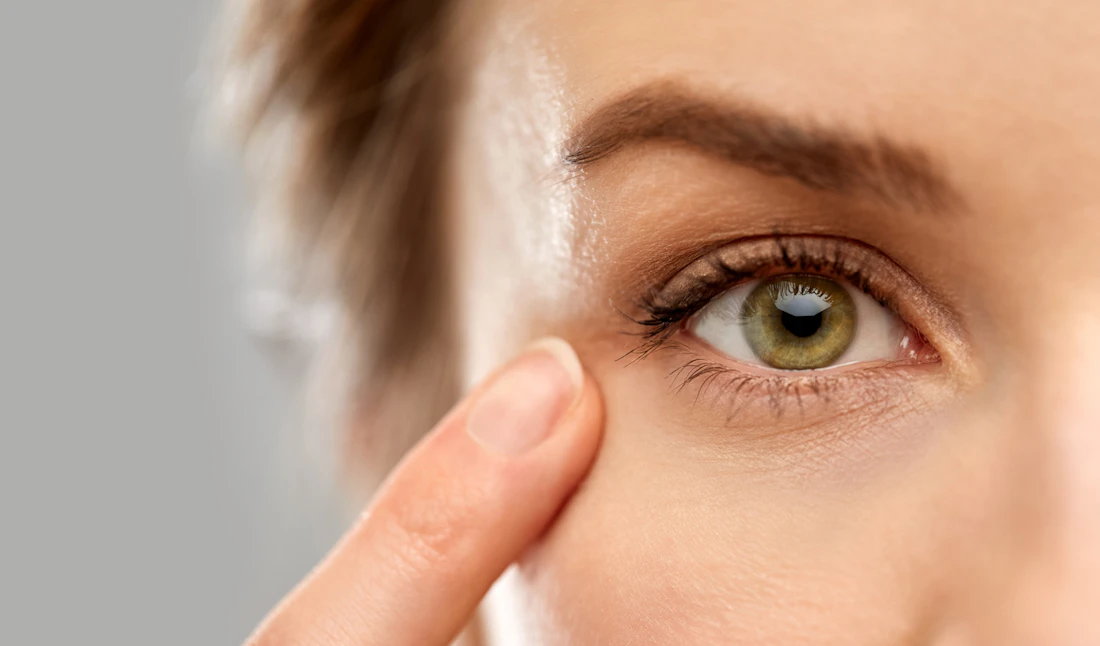
Light coming from the outside enters the eye via the pupil. The pupil adapts to the level of brightness of the environment, by varying in size to let more or less light come into the eye.
At the back end of the eye, the retina acts as the image sensor. Its surface is covered by about 120 million photoreceptor cells which react to light intensity - called rods - and 6 million cells that enable us to see colours - called cones.
Light reaches the retina via the crystalline lens, which is the equivalent of the lens in a camera. When the lens is well-shaped and fits the length of the eye, sharp focusing on the retina results in a clear image.
Surrounding the crystalline lens are muscles that can bend the lens itself. This enables the eye to focus at up-close distances.
A normal eye can see in the far distance without muscular effort, but when looking at close distance, these muscles are constantly contracted. Imagine trying to take a macro photo with your phone’s camera: sometimes it struggles to properly focus on subjects up-close, and our eyes are no different!
The normal eye can easily focus both from afar and at close range
- Distance vision includes driving, watching TV or looking at a school board
- Near vision includes reading , working on a computer or scrolling through a phone => There is no fatigue or tired eyes.
The eye changes the overall power when you need to look up close. This is called accommodation.
The extra power comes from the crystalline lens. It thickens, thus changing the curvature, to make it more powerful!
Hold a piece of paper as close as possible to your face whilst keeping the paper in focus. What you can feel is the lens working hard (in other terms, accommodating) to generate all the extra power!