
Presbyopia
Presbyopia usually occurs around the age of 40, even if you have never had any vision problem before. You may start to experience blurry vision when reading or looking at your smartphone. Focusing between distances can also become gradually difficult.

It is a natural consequence of the eye’s ageing process: the crystalline lens loses its elasticity from the age of 40 onwards, and the vision loses its clarity. The crystalline lens is a transparent lens located inside the eye. In order to see correctly at close distance and to obtain a clear image, the lens bulges and increases in size to change its refractive power. It is this phenomenon that makes it possible for the eye to focus, the very same principle used by the autofocus of a camera.
The term presbyopia thus refers to the loss of flexibility of the lens that makes accommodation – namely focusing – increasingly difficult.
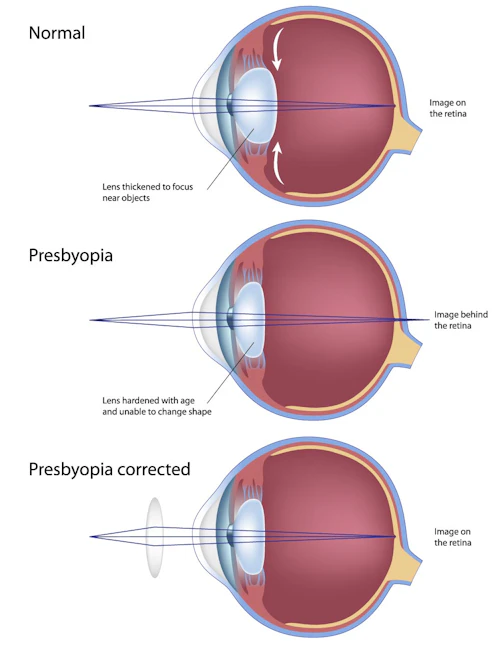
The main symptoms are :
- Need to move backwards to get a good close-up view
- Need for more light to be able to read
Progressive lenses are the best option to address presbyopia. Nikon offers a wide range of choices that will offer superior optical performance, better aesthetics and comfort - all within a single lens.

Delaying wearing glasses does slow down the development of presbyopia: FALSE
At the beginning of presbyopia, the eye muscles redouble their efforts to bulge the crystalline lens, which by then has become rigid. This over-stressed accommodation is responsible for visual fatigue and headaches. Wearing progressive lenses relieves the eye of these efforts while allowing the eye to see perfectly both near and far.