
When Should I Consult An Eye Specialist?
It is fundamental to treat our eyes with the greatest care throughout our whole lives. Ignoring changes in vision or skipping eye examinations put this essential sense at risk.
The Canadian Ophthalmological Society (COS) recommends that adults see an ophthalmologist as soon as possible if you experience any of the following symptoms:
- Loss of vision or decreased vision in one or both eyes
- Changes in vision such as sudden spots, flashes of light, lightning streaks or jagged lines of light, wavy or watery vision, blurry faces, distortions or wavy lines, halos around lights, double vision
- Changes in the field of vision such as shadows, curtain-like loss of vision, black spots or blurriness in central or peripheral (side) vision
- Physical changes to the eye such as crossed eyes, eyes that turn in, out, up or down, pain, signs of infection (redness, swelling, discharge, etc.)
- Changes in colour perception

Before Age 5
Unfortunately, it is possible for your child to have a serious vision problem without him/her realizing it. Hence why your little one should have his/her eyes screened at age 1, 3 and 5 by an eye care professional, primary care provider, family physician, paediatrician or trained screener* for eye conditions such as:
- Strabismus (crossed eyes)
- Amblyopia (lazy eye)
- Ptosis (drooping of the upper eyelid)
- Refractive errors (shortsightedness, farsightedness and astigmatism)
What to expect during your child’s eye exam with an optometrist?
The optometrist's exam consists of a comprehensive eye examination designed to identify potential diseases, including a refraction test that assesses your child’s vision, and a visual function/eye health assessment.
Your child’s eyes will be dilated for the first visit and may be dilated on future visits depending on the optometrist.
How Often Should You Have Your Eyes Examined?
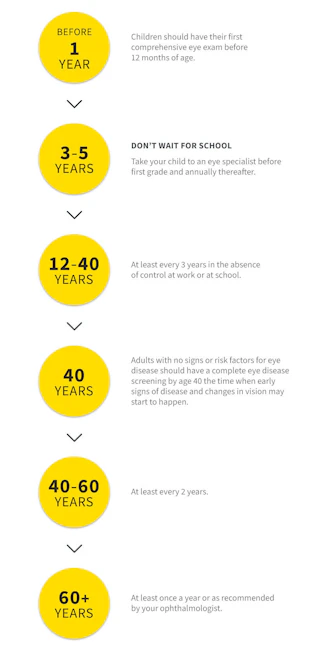
*A brief examination of your child’s eyes and a vision screening by a paediatrician or family practice doctor is not a substitute for an eye exam performed by an eye doctor.